Special Focus : Reimagining Education for a Better Future
Working successfully through crisis depends on real leadership. As unpredictability flows across every organizational plane, school leaders are tested emotionally, cognitively, and practically. This has been no more apparent than through the fragility induced by the ongoing coronavirus emergency.
The crisis has generated conditions throughout our communities that have twisted understandings and challenged established leadership norms, even those bred during previous disruptions. Leaders have few roadmaps to guide their actions—there are few go-to answers as things change almost day-to-day. Given the absence of previously tested traditions, the leaders who appear most successful are not those who believe they hold complete answers, but those who see their leadership as treading uncertainly through sets of dissonance-fed tensions. A tension is a situation which has no clear resolution, no absolute answers; but rather presents multiple often contradictory pathways, which tear them in different directions.
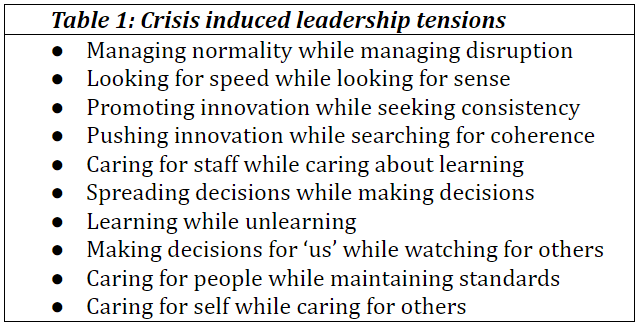
Those who manage the tensions intentionally, yet flexibly, seemed to be able to at least walk their communities through the crisis in positive ways. Table one lists some of the most common tensions confronting leaders in this crisis. Four of these are now teased out in a little more detail.
Leader Tensions
Managing normality while managing disruption: When faced with crisis, people look to their leaders for a sense of normality or security, they need to know things are OK. So, leaders are called upon to become and maintain a stability platform upon which people can live and work—a values-based platform which people can ‘feel’ while much around them seems to crumble. On the other hand, leaders must help people manage the disruption to their lives and work and ensure their students and communities do not freeze up, and can react in sensible, positive ways.
Promoting innovation while seeking consistency: Dealing with crisis requires creative thinking and bold action. This does not just flow from leaders, but from throughout the organization. As the unpredictable rules, leaders give staff space to design and enact innovations in their areas of responsibility and care. But, concurrently, leaders are responsible for maintaining a measure of consistency across the organization. This entails working to see that the best ideas don’t just take hold in patches but are spread for the benefit of the entire community, regardless of where they came from.
Caring for people while maintaining standards: When crisis strikes a leader’s first duty is to care for their community—teachers, students and others. This means doing everything possible to secure peoples’ safety—physically, psychologically, and relationally, and keep uncontained fear under perspective. Providing care is a nonnegotiable, if fear reigns things will quickly spiral downward, however, crisis cannot be reason to drop standards. Even, if not especially, during crisis, organizations must retain their purpose and the expectations which define this—leaders are the guardians of standards and expectations. Even as context churns leaders must hold to high standards.
Caring for self while caring for others: This sounds simple, but it is not. The tendency of committed leaders in crisis is to plough everything into the care and sustainability of their people and community, too often at the expense of their own wellbeing. While this feels like the right thing to do and is sometimes even expected, it can actually be counterproductive. Organizations in crisis need leaders who are sharp, alert and together, and this won’t happen if leaders don’t care for themselves physically and mentally while riding through the crisis
Forged in crisis
Many claim leaders are forged in a crisis. That is, crisis tells us who we really are as both people and leaders. Tussling with the tensions, which inevitably fasten themselves to crisis may well be the process through which we are forged. Leading through the continuity of disruption is not about balance, it’s not even a matter of evenness—it’s about having the right values to work iteratively through the mire of uncertainty which manifests as tensions—it is here we are forged for the future.
Our experience tells us that the leaders who best do this can be labelled as pragmatic visionaries. Those who maintain both a short and future-pointed purpose, become the stability platform upon which others’ work and lives rest, care, stay relationally connected, are humble about what they can do, maintain their energy, have and provide hope, and are mentally tough.