The rise of AI-powered technologies (e.g. ChatGPT) has triggered a series of transformations that have impacted both our personal and professional lives.
But the transformations that come with the advent of AI are far from being only economical: for many people, work is more than a job. As shown in a McKinsey research, “70% of employees say their personal sense of purpose is defined by their work.” So, how will our relationship with work change in the future, in light of the recent AI revolution?
How AI is transforming the world of work
Even though 50% of organizations believe that AI will foster job growth more than job losses or, in other words, that it will augment work, not automate it, what’s likely going to happen is that millions of jobs will be impacted by the advent of these new technologies.
As stated in a Goldman Sachs’ report launched earlier this year, up to 300 million jobs could be disrupted by AI-powered chatbots such as ChatGPT. According to the World Economic Forum’s Future of Jobs report, over the next 5 years “69 million new jobs are expected to be created and 83 million to be eliminated, a net decrease of 14 million jobs around the world.”
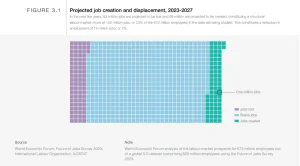
Source: World Economic Forum
Automation has caused a lot of anxiety for some workers, who fear losing their jobs to AI-powered tech. 30% of the respondents to PwC’s Global Workforce Hopes & Fears survey were concerned about the possibility of being replaced by technology in the next 3 years.
Looking even further into the future, in a recent conversation with British Prime Minister Rishi Sunak, businessman and investor Elon Musk mentioned that: “It’s hard to say exactly when that moment is, but there will come a point when no job is needed. You can have a job if you want to have a job for personal satisfaction, but the AI will be able to do everything.”
Work as a source of meaning in life
Following Musk’s statement, where will we find meaning if, at some point in the future, the main source of purpose for many people disappears, or is radically transformed?
Sunak echoed Musk’s remarks, as he also argued that “work is a good thing that gives people purpose in their lives and, if you remove a large chunk of that (i.e. work), what does that mean for individuals, and where will they get that drive, motivation and purpose from?”
Work as a source of purpose is a relatively new concept. Aaron de Smet, a Senior Partner at Mckinsey, referred to this concept in a BBC article published about a year ago: “the Industrial Revolution (…) made work very ‘transactional’: people worked and got paid money to live, while no greater purpose was required or expected of them.” He explained, “over time, as decent working conditions and a pay cheque became simple fundamentals, workers began to want more.” Similarly, through his Hierarchy of Needs theory, psychologist Abraham Maslow explained how, once our primary needs are satisfied, new needs emerge.
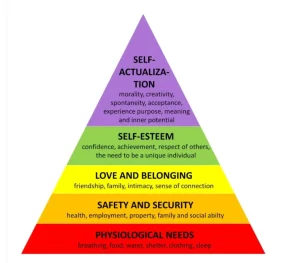
Source: SimplyPsychology
That’s how, today, our jobs became a great part of our identities and a source of meaning in life for so many people around the world. This is what journalist Derek Thompsom referred to when he coined the term workism: “the belief that work is not only necessary to economic production, but also the centerpiece of one’s identity and life’s purpose.”
Life beyond work
As the role work plays in our lives evolved from a means to put food on the table, to what it represents today, an important source of meaning in our lives, the AI revolution threatens to change the role work plays in our lives once again, and more profoundly than ever before. If, as Elon Musk predicted, in the future we will find ourselves without the need to work anymore, given the productivity gains from AI, how will we be able to find purpose in life?
Simone Stolzoff, a San Francisco-based writer, designer, and work expert has questioned the concept of work as a source of meaning in his book, The Good Enough Job, which was published earlier this year. Stolzoff explores the reasons why work came to take such a central role in shaping our identities, and explains that “our jobs are not necessarily designed to bear this burden of being our main source of meaning and self-actualization.”
Perhaps the transformations derived from the advent of AI are also a chance for us to reflect on the role work plays in our lives, like Stolzoff argued in his book, and look for meaning in other aspects of our lives, such as in our hobbies or our volunteering activities.