A child’s first teacher is, almost always, a parent or carer. Parents are central in the development of a child’s social, moral, and cultural learning journey. Today, on Global Day of Parents, we celebrate parents worldwide, and recognize their role as activists within local communities, especially during a time of crisis.
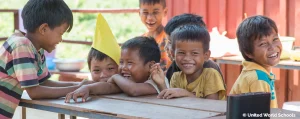
When United World Schools (UWS) developed our first school in 2009, UWS Korng Nork School in a remote indigenous minority community in North-East Cambodia, we wanted the project to be supported from the outset by a committed group of community leaders. We called them the ‘school support committee,’ and asked the village leaders to consider two criteria for membership: the group should include parents and be gender balanced.
Eleven years, 35,000 children, and 229 free-to-attend schools later, the same principle still applies. Engaged parents are key to our model and the successful operation of a community school in remote regions. Whilst the COVID-19 pandemic has temporarily closed UWS schools, our teams have focused on making sure parents can help their children to stay safe and continue to learn at home.
This is, of course, the same story for millions of parents and their children around the world. And parents around the world should be congratulated for keeping learning and children’s studying going in these extremely challenging times. Adding ‘learning supervisor’ to parents’ long to-do list is, by any standard, a significant addition.
Yet the challenges faced by parents are not equal. The World Bank warns that poorer families are being hit disproportionately hard by the pandemic. And, based on evidence from crises like Ebola, the most vulnerable in each community will be most affected. This includes women, girls, the poorest, and those with disabilities.
We have schools in remote regions of Cambodia, Myanmar, and Nepal where the ethnic minority communities are extremely poor and have very limited healthcare facilities. Adult literacy rates are often as low as 10 percent. Very few parents speak the national language, and therefore can’t easily access government services. It is a really tough existence.
Yet this doesn’t mean that ethnic minority communities are not resilient. We should avoid stereotyping the more vulnerable as, somehow, less ‘capable’. In fact, without the benefit of a social care system that more affluent countries can put in place, remote and poor communities have to demonstrate extraordinary resilience. And they do, daily.
By working with parents and leaders in each community, we have been able to leverage their relationships of trust with the wider community throughout the COVID-19 pandemic.
Following recommended practice from Translators Without Borders, our communication strategies focused on the needs of the target population. This means that key messages about handwashing, social distancing, and how to learn at home are delivered in the mother-tongue of the community, by a trusted community leader, and supported by UWS staff.
UWS moved from basic elementary school to health education in a matter of weeks. We believe it’s imperative that program design and innovations should be made with local communities at the core, and this principle came to the fore in our strategy during COVID-19.
When this is over (and it will be) UWS will reopen our schools. We will continue to support and empower hundreds of people in each community with the help of parents and community leaders.
Thank you to every parent and carer who has helped their child continue to learn during these challenging times.