As education actors around the globe consider the current crisis, I have been struck by the possibility of building back better. How can we leverage lessons from this season of crisis to do better for all children in the future? There are five key lessons from Dignitas’ initial response that I know have a much longer-term application.
What is not counted, measured, and spoken to will not be given the necessary attention. Data that can inform evidence-based decisions is critically important. Those in power, or holding important resources, cannot invest their power and resources otherwise.
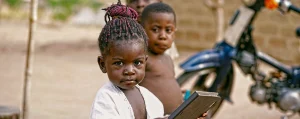
We have a moral obligation to stop the children furthest behind being left behind completely. The crisis of COVID-19 has exposed the systemic inequality that exists globally. For many of the communities in which Dignitas works in Kenya, the struggle during this pandemic is not for comfort, but for survival. COVID-19 has brought with it severe social, health, and economic hardship, and these hit the poorest communities the hardest. In these communities, 63% of families were unable to access public education pre-COVID-19, as a result of poverty and systemic exclusion. Marginalized by poverty, these are the same families excluded from a myriad of essential health and education services now.
Our recent survey demonstrated that 79% of households in our communities currently have no household income and, understandably so, education is third in their list of most pressing concerns, after food and nutrition, and household finance. For the 83% who did list education as a pressing concern, there are other barriers—only 35% of parents have completed secondary education, and 71% of those struggling say they don’t have access to learning resources.
This raises critical, urgent questions of ‘What happens next?’ When schools reopen, will those who have participated in online or home learning be ‘ahead’ of others? How will schools assess progress and promote students to the new school year? How many girls will be married or pregnant, never to return to school? How many families will end up on the street, their children never to return to school? How many children will have died from starvation? How many children will be so scarred by the trauma, violence, and anxiety of this season that learning never really resumes?
Our response has to be strategic, at the correct pace, and of excellent quality. Twenty years in education and child protection in the development sector have taught me that quality is not synonymous with perfection. Quality is listening to our school leaders, our learners, and their communities. Quality is coming alongside school leaders, families and learners as friends and partners, and not being so patronizing as to classify them all as ‘beneficiaries’ as if the learning, value and growth was a one-way street. Quality means thinking holistically about solutions. Quality means evidence based. Not so that Dignitas can tick boxes, or report a certain number, or gain acclamation; but so that we are all authentically pursuing the best for those we partner with.
You can’t have quality interventions without a quality workforce. Dignitas’ recommendations to Kenya’s National COVID-19 Education Response Committee focused on exactly this. Leadership matters; the human capacity within a system matters. Without equipping and empowering the workforce, any interventions will only be temporary and surface level.
It is not business as usual. We have to innovate. We have to throw away the box (as opposed to simply thinking outside of it). I have found innovation to be a space of hope, a space for optimism. How can we change the systems that have been consistently ineffective, consistently unequal, and consistently blind to the social and emotional needs of our children, teachers, and school leaders?
We are stronger together. Dignitas has found this to be a fruitful season of learning and impact because we have pursued strategic partnerships and collaborations that enable us to respond well to crisis. Thought partners, action partners, resource partners. As soon as schools closed, our partners Global School Leaders helped us to survey 200 School Leaders in Kenya as part of a global initiative. In collaboration with regional education actors in RELI Dignitas helped to develop a list of eight recommendations to cater to children in marginalized communities during the COVID-19 crisis.
With a laser focus on these five principles, and in an effort to reach and protect children furthest behind, Dignitas is currently remotely training and coaching 300 educators as Community Champions who are working to protect and promote children’s learning and well-being across 6,000 households during school closures. Whilst everything else is disrupted, our vision to ensure all children have the opportunity to thrive and succeed remains core to our COVID-19 response.
Learning is no longer confined to school buildings, and neither is educational leadership. Let’s be sure to apply these learnings so that we continue to reach children out of school, beyond the end of COVID-19 school closures.