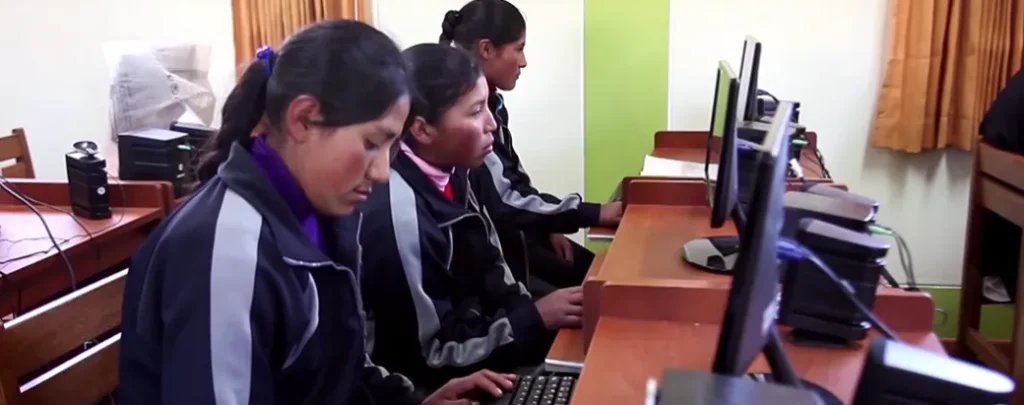
This project is one of the 2014 WISE Awards winners.
For several reasons young people in Peru’s rural communities usually leave secondary school early. They are needed to work at home. Long distances to school and perceived irrelevant educational content also lower the value of school from the perspective of many parents. This results in a perpetuation of poverty and the lack of jobs and productive opportunities which could support community development. The project promotes an innovative Alternate Education program recognized by the Peruvian government as a successful learning model for rural areas. The proposed program aims to create permanent interaction between social and professional development and school life in which students alternate between home and school for two-week periods.
The core problem is that standard school content is designed for young people living in cities (in Peru, 83.7 percent of young people in urban areas have access to secondary school, compared to 66.4 percent in rural areas). The high dropout rate in rural areas is related to the lack of relevant educational programs designed to meet the specific needs of rural people.
This project takes a holistic approach to rural education by addressing various problems:
- School timetables that do not consider agricultural calendars and the long distances which students have to travel to school
- Irrelevant educational content, disconnected from the realities of rural life
- Poor quality of technical and learning content and school management
- Little participation of rural people in decision-making
- The government’s inadequate management of rural education
The project shifts the focus to rural young people, developing an educational program specially adapted to their needs. It tackles education challenges in the following ways:
- Students spend two weeks alternating between home and school where they board, reducing travel time.
- Design of school curricula is adapted to rural realities and with special focus on practical issues
- Continuous training of teachers
- Involvement of parents in school management and teacher training
- Promoting the project as a successful learning model in rural areas through its recognition by the Peruvian government.
The project includes:
1) Adaptation of school curricula to the rural environment,
2) Recruiting and training rural teachers,
3) Involvement of parents in school management and teacher training,
4) Providing accessible and nearby facilities and infrastructure.
Through the project, students receive a well-rounded education. The methodology has been successfully used since 2002, and is now implemented in 40 alternate rural schools (ARS) in 11 Peruvian regions, assisting 2,823 young people. In 2013 1,657 young people in the project completed secondary education. Of those who finished school before 2012, 52 percent are in tertiary education and 68 percent are working independently. 78% remain linked to their families and communities and 31% of them are developing business plans. The project supports increased family income. In many cases, the new businesses finance tertiary education.
This project is being developed and has been recognized as an innovative educational program by the Ministry of Education in Peru. The objective for the coming years is to extend its scope to the whole country, and ultimately for local authorities to lead and finance the project throughout rural Peru. The implementation plan will be carried out in selected schools with the following activities:
- Selecting schools and communities
- Developing a working plan with the Ministry of Education
- Improving and structuring the project’s knowledge base
- Elaborating a strategic communication plan to improve the dissemination of the project.