
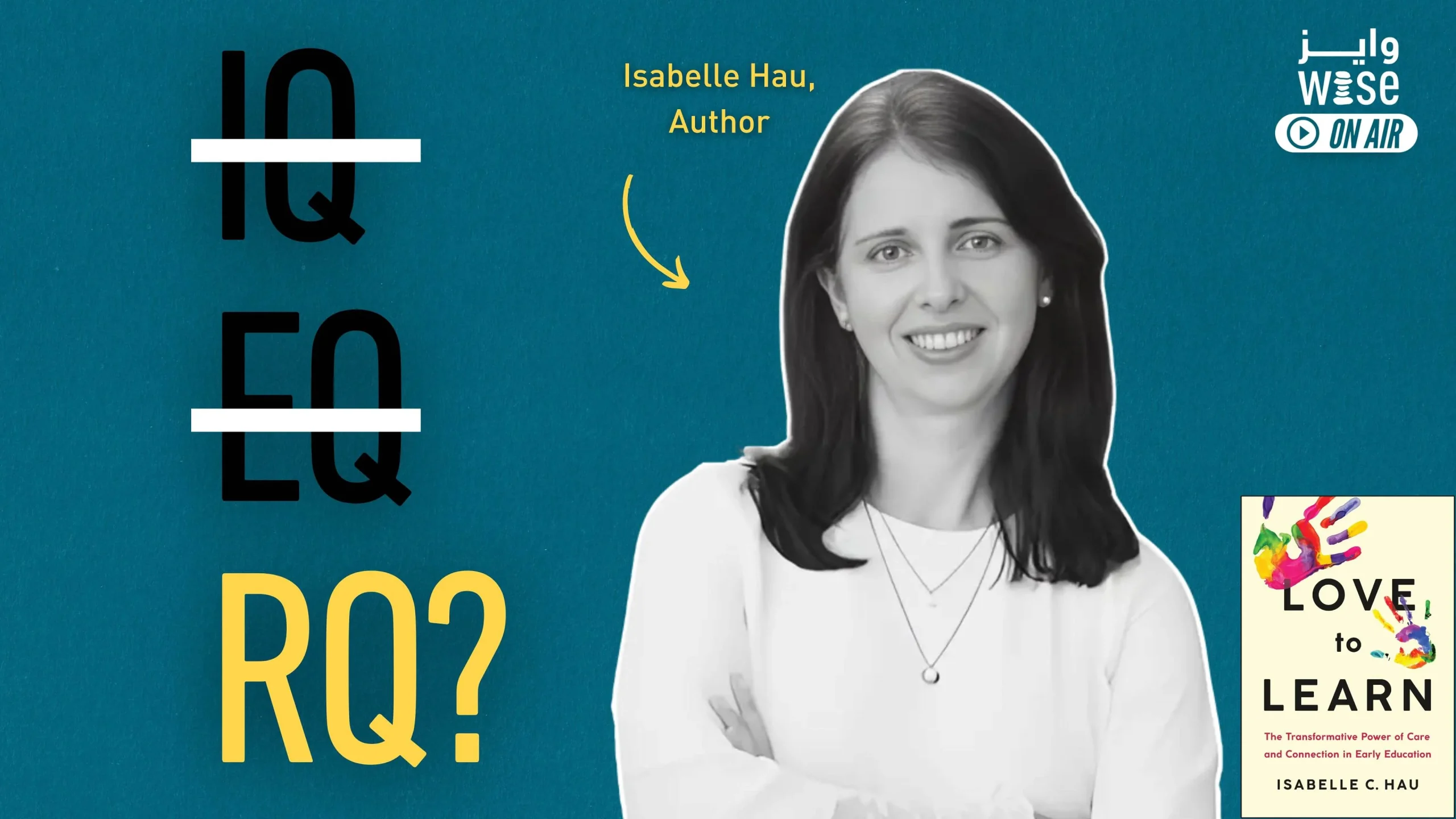
In this episode of WISE On Air, we explore how relationships shape learning with Isabelle Hau, author of ‘Love to Learn’ and Executive Director of the Stanford Accelerator for Learning.
The Relational Crisis Affecting Children Today
What if the secret recipe to learning and thriving starts with a simple key ingredient: early loving relationships? This is the compelling argument made by Isabelle Hau in her groundbreaking book “Love to Learn,” where she introduces the concept of “relational intelligence” (RQ) – a form of intelligence she believes is even more critical than IQ or EQ in today’s collaborative world.
In conversation with WISE CEO Stavros Yiannouka, Isabelle sheds light on the alarming “relational crisis” affecting children worldwide. The data is concerning: only 40% of young children had strong emotional connections with caregivers before the pandemic, dropping to just 20% during COVID.
“Loving relationships are precisely what so many children are missing, with grave implications for them and for the world,” Hau explains.
The Science Behind Relationships and Brain Development
The science of relationships is compelling. Nurturing relationships lead to better academic outcomes, social development, and even increased longevity. Conversely, the absence of loving relationships can have devastating effects.
Hau points to research on Romanian orphanages, where children deprived of nurturing relationships showed profound differences in brain size and activity – approximately 10% smaller brains with significantly reduced activity compared to adopted children.
“Relationships literally change the brain,” emphasizes Hau.
Three Drivers of the Relational Crisis
According to Hau, three key factors are contributing to the relational crisis:
-
- Shrinking social networks: Smaller families, increased distances between relatives, and reduced community connections mean children have fewer meaningful relationships.
-
- Over-scheduled activities: While structured activities are beneficial, the decrease in free play time limits children’s ability to develop authentic friendships and relational skills.
-
- Technology interference: The average person checks their device 205 times daily, creating constant interruptions in potential moments of connection with children.
Redefining Success Beyond IQ and Academics
For decades, our education systems have prioritized cognitive intelligence (IQ) and academic outcomes. More recently, emotional intelligence (EQ) has gained recognition. However, Hau argues that “relational intelligence” (RQ) is what today’s and tomorrow’s world truly demands.
“In education systems, words like ‘achievement’ and ‘excellence’ dominate,” Hau notes. “Very rarely do we hear concepts of love or relationships, when in fact, they are some of the most important drivers of learning.”
Practical Solutions for Parents, Educators, and Communities
Hau offers actionable recommendations for different stakeholders:
For families:
-
- Ensure family time becomes relational time
-
- Create screen-free periods, especially during meals and before bedtime
-
- Prioritize uninterrupted play and reading sessions
For schools:
-
- Protect and enhance recess time
-
- Support teachers as “relational brain builders”
-
- Measure relationship quality alongside academic outcomes
For communities:
-
- Create flexible learning models between family and traditional school systems
-
- Establish community playgroups with scaffolded activities
-
- Advocate for relationship-centered activities and spaces
The Role of Technology: Force for Good or Relational Barrier?
While technology often interrupts human connections, Hau isn’t anti-tech. She distinguishes between what she calls “junk tech” (similar to junk food) and “relational tech” that enhances human connections.
“I would love to see more intentionality around technology,” she says. “We need better tools to help us distinguish between technology that enhances relationships and technology that hinders them.”
A Call to Action
Hau’s message is simple yet profound: don’t take relationships for granted. They are at the core of learning, development, and lifelong success.
“My call to action is to recenter on something we all know is important. We all know relationships matter. I’m not bringing anything new here, but we take it for granted,” Hau emphasizes. “If anything, relationships are the crisis of our times.”
Purchase Isabelle’s book ‘Love to Learn’ for more insights: https://www.hachettebookgroup.com/titles/isabelle-c-hau/love-to-learn/9781541703773/
Resources Mentioned in This Episode:
-
- Pretend play research (Sansanwal, 2014): https://www.researchgate.net/publication/266081256_Sansanwal_S_2014_Pretend_play_enhances_creativity_and_imagination_Journal_of_Arts_and_Humanities_31_70-83
-
- Childhood neglect impact on brain development: https://www.apa.org/monitor/2014/06/neglect
-
- Early life adversity and neural development: https://psycnet.apa.org/record/2023-04894-001?doi=1
-
- Neural synchrony between students and teachers: https://www.science.org/doi/10.1126/scitranslmed.abq4786
Listen to the full episode on all major podcast platforms or watch on YouTube.