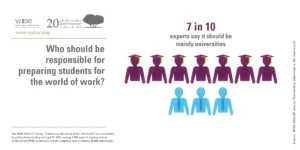
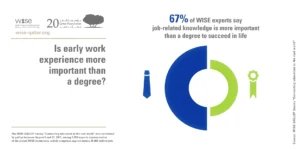
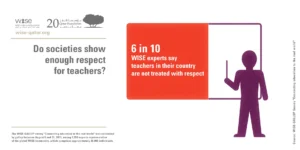
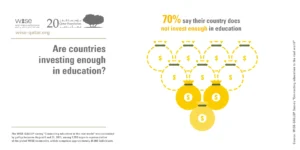
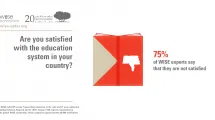
The survey’s key finding is that three in four WISE education experts are dissatisfied with education in their respective countries. The majority also believes their nation’s educational system has not improved in the past decade, and few give their system high marks (rating of “4” or “5” on five-point scale) on innovation. WISE experts believe the failure to provide students with opportunities to apply what they know while they are still on their educational journey is a leading flaw in modern-day education.
The challenges facing education systems around the world are numerous and vary greatly from region to region. In the world’s poorest regions, such as Sub-Saharan Africa, huge progress has been made in primary school enrollment, but secondary school participation remains uneven and higher education opportunities are rare. Many Middle Eastern/ North African countries face huge challenges in reforming educational curricula to promote job growth, particularly in the private sector. In Latin America – and increasingly in the U.S. – differences in access to higher education have promoted rising levels of income inequality.
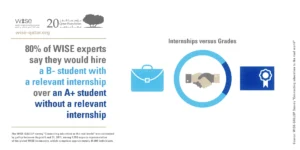
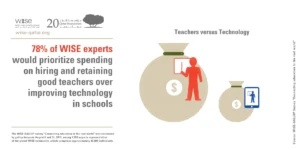
At the same time, the survey reveals a surprising amount of consensus among experts worldwide on several dynamic solutions that, collectively, could transform education and therefore have dramatic implications for the world’s economic performance. There is broad support for reimagining education as a partnership between schools and employers in order to provide students with meaningful, real-world experience in their field before they graduate. Further, many WISE experts believe such partnerships are not only needed at the university level, but also at the primary/secondary levels. Experts also favor making greater investments in teachers, both in terms of pay and enhanced professional development opportunities. While WISE experts consider technology to be a valuable educational tool, they are clear that technology has the most to offer when it is incorporated in the classroom by a high-quality teacher.